
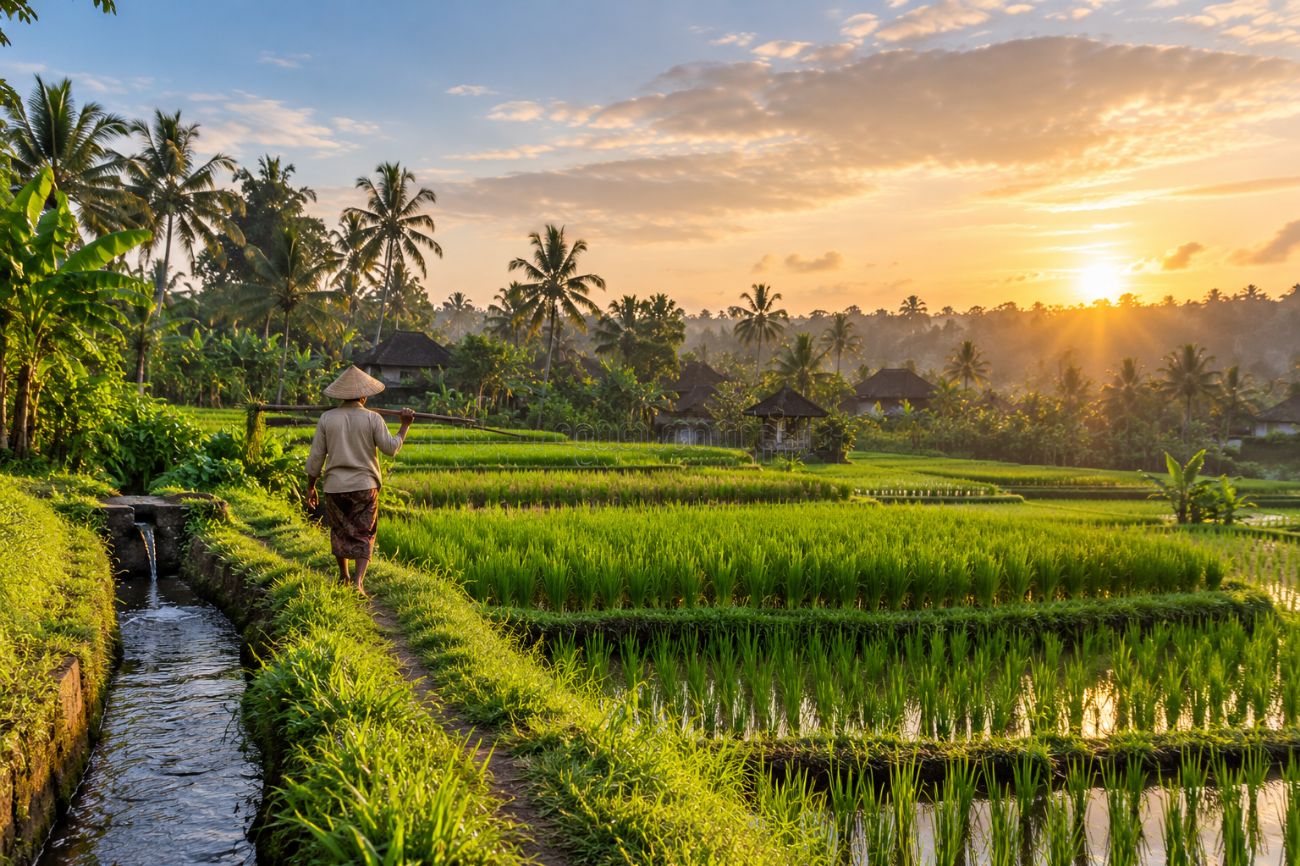
Ubud’s rice fields are beautiful, but their importance goes far beyond the view. Behind the layers of green terraces and narrow paths is a working agricultural landscape shaped by water, farming communities, local knowledge, and traditions that have developed over generations.
For visitors, rice fields can easily become part of the scenery: somewhere to walk, take photographs, or watch the changing light. For the people who cultivate them, however, these fields are places of work and food production, connected to systems of cooperation and aspects of Balinese cultural and spiritual life.
Understanding that difference can transform the way you experience Ubud.
Rather than seeing rice fields only as attractions, you begin to see a living landscape—one that changes with planting and harvesting, depends on carefully managed water, and continues to play a role in everyday life.
At Wapa di Ume Ubud, rice fields are also part of the surrounding landscape, offering guests an opportunity to experience this quieter side of Ubud while remaining close to the centre of town.
Quick Answer
Ubud’s rice fields are more than picturesque landscapes. They are working agricultural areas where rice cultivation is connected to water management, cooperation between farmers, community life, and Balinese traditions.
An important part of this story is subak, a cooperative system through which farming communities manage water for rice cultivation. In Bali, the broader cultural landscape associated with subak also connects agriculture with water temples, rituals, and the philosophy of Tri Hita Karana.
For visitors, understanding these connections offers a more meaningful way to experience Ubud’s rice fields—not simply as places to photograph, but as landscapes that continue to live, change, and support local communities.
Key Takeaways
- Ubud’s rice fields are working agricultural landscapes, not simply tourist attractions.
- Rice-field scenery changes throughout the planting and harvesting cycle, so the fields are not always bright green.
- Subak involves cooperative water management and is connected to the social and cultural life of Balinese farming communities.
- The cultural landscape associated with subak has connections with water temples and the Balinese philosophy of Tri Hita Karana.
- Tegallalang is one of the best-known rice-terrace destinations near Ubud, but it is not the only place to experience rice-field landscapes.
- Visitors should stay on appropriate paths, respect agricultural activity, and remember that some rice fields are private working land.
- At Wapa di Ume Ubud, guests can discover more about the surrounding landscape through a guided Rice Paddy Trekking experience.
Why Rice Fields Are Part of Ubud’s Identity
Ubud is widely known for art, temples, dance, wellness, and its creative community. Yet beyond the busy streets and cultural attractions, agriculture remains an important part of the wider landscape.
Rice fields appear between villages, beside roads, behind homes, and across valleys throughout the Ubud area. In some places, terraces follow the natural contours of the land. Elsewhere, flatter paddies stretch between clusters of houses and tropical vegetation.
These landscapes are not static.
They change as farmers prepare the soil, plant young rice, manage water, tend the growing crop, and eventually harvest it. The colours and textures visible to visitors are therefore part of an agricultural cycle rather than a permanent landscape designed for tourism.
This helps explain why rice fields feel so closely connected to the identity of Ubud.
They are simultaneously part of the scenery, a source of food, a place of work, and a landscape shaped by relationships between people, water, land, and tradition.
Rice Fields Are Working Landscapes, Not Just Attractions
It is easy to understand why travellers are drawn to Bali’s rice fields.
The geometry of terraces, reflections in water-filled paddies, young green rice plants, and mature golden crops can create extraordinary landscapes.
But beauty is only one part of their story.
A rice field is first and foremost an agricultural space.
Farmers may be preparing soil, managing water, maintaining boundaries, planting, tending crops, or harvesting while visitors are walking nearby. Narrow paths that look like scenic walking routes may also provide practical access between fields.
This distinction matters.
Treating every rice field as a tourist attraction can disconnect the landscape from the people whose work maintains it. A more respectful approach is to enjoy the scenery while remembering that you are observing an active agricultural environment.
That perspective can make a rice-field walk more interesting rather than less.
The muddy field you see today may soon hold young rice plants. A bright green paddy may gradually change as the crop matures. A recently harvested field may appear less dramatic in photographs, yet it represents another important stage in the same cycle.
The landscape is beautiful partly because it is alive and constantly changing.
What Is Subak?
Subak is a cooperative system through which Balinese farming communities manage water for rice cultivation.
It includes the practical distribution of water across agricultural land, but understanding subak only as an irrigation technique misses much of its significance.
The system is also connected with cooperation between farmers, water temples, rituals, agricultural practices, and relationships between people and their environment.
UNESCO describes Bali’s subak cultural landscape as an expression of the Tri Hita Karana philosophy, which brings together spiritual, human, and environmental relationships.
More Than an Irrigation System
Water is essential to wet-rice cultivation.
Getting that water to different fields requires more than simply digging a channel. Water must move through a landscape where fields may sit at different elevations and where multiple farmers depend on the same wider water system.
Cooperation therefore becomes essential.
The subak system provides a framework through which water can be managed collectively for rice cultivation. Networks of canals, channels, and water-control structures help distribute water through agricultural areas.
But the physical infrastructure is only part of the system.
The people who cooperate around it are equally important.
This is why describing subak simply as an “ancient irrigation system” can be misleading. Irrigation is central to its function, but subak also reflects social organization, shared responsibilities, agricultural knowledge, and cultural traditions.
Water, Farmers and Community
Rice cultivation creates a practical reason for cooperation.
Water flowing through one part of a landscape can affect fields elsewhere. Decisions about its distribution therefore have consequences beyond an individual farmer’s plot.
Subak helps farming communities coordinate around this shared resource.
This relationship between water and community is one reason Bali’s rice landscapes cannot be fully understood by looking only at individual terraces.
What appears to visitors as a collection of separate fields may form part of a much larger agricultural system.
The landscape is connected.
Water Temples and Spiritual Life
The cultural dimensions of subak also extend beyond agriculture.
Water temples have an important place within Bali’s subak landscape, connecting the management of water with ritual and spiritual life.
UNESCO’s description of the Cultural Landscape of Bali Province highlights this relationship between the cooperative water-management system, temples, rice cultivation, and Tri Hita Karana.
This does not mean every rice field or agricultural practice across Bali is identical. Local traditions and practices can vary.
Instead, it shows why the relationship between water and rice cultivation in Bali has cultural dimensions that cannot be explained through engineering alone.
What Is Tri Hita Karana?
Tri Hita Karana is a Balinese philosophical concept centred on harmony in relationships involving the spiritual world, people, and nature.
The concept is particularly relevant when discussing Bali’s UNESCO-recognised subak cultural landscape because UNESCO identifies it as an important philosophical foundation of that landscape.
In practical terms, it offers a way of understanding why rice cultivation can involve more than agricultural productivity.
The relationship with nature is visible through land and water.
The relationship between people appears through cooperation and community organization.
The spiritual dimension is reflected through temples and ritual life.
These relationships help explain why Bali’s rice landscapes have cultural significance beyond their visual beauty.
For travellers, this context provides another way of looking at the fields around Ubud. What appears to be a simple agricultural landscape may also reflect a much wider network of human, environmental, and cultural relationships.
How Rice Is Grown in Bali
Rice cultivation is a cycle, which is why the appearance of rice fields changes over time.
Exact practices and timing can differ according to location, water conditions, rice variety, farming decisions, and other local factors. However, visitors may encounter several recognisable stages when travelling through rice-growing areas.
Preparing the Fields
Before planting, fields need to be prepared for the next crop.
At this stage, paddies may appear wet, muddy, brown, or relatively empty. Water may be introduced and the soil prepared before young rice plants are established.
For travellers expecting endless green terraces, this stage can look surprising.
Yet it is an essential part of the agricultural process.
Planting the Rice
Young rice plants are established in the prepared fields.
At this stage, the landscape may show neat lines of small green plants surrounded by water or dark soil.
Over time, the plants grow taller and denser, gradually transforming the appearance of the field.
Growing and Managing Water
As rice develops, water management remains important.
The fields can become intensely green during parts of the growing cycle, creating the scenery many visitors associate with Bali.
Behind that appearance, however, agricultural work continues.
Farmers monitor the crop and field conditions while water moves through the wider agricultural landscape.
Harvesting
As the rice matures, colours can shift from green towards warmer yellow or golden tones, depending on the crop and stage of maturity.
Eventually, the rice is harvested.
After harvest, the landscape changes again before another growing cycle begins.
Why Ubud’s Rice Fields Are Not Always Green
There is no single moment when every rice field around Ubud becomes bright green at the same time.
Different fields can be at different stages of cultivation.
One field may contain young plants while another nearby is approaching harvest. A third may have recently been harvested or be undergoing preparation for the next planting.
Weather, local conditions, planting decisions, and agricultural cycles can all affect what visitors see.
So if you encounter muddy, newly planted, golden, or recently harvested fields, you have not necessarily arrived at the “wrong” time.
You are simply seeing another stage of a working landscape.
Rice, Rituals and Balinese Community Life
Rice has significance in Bali that extends beyond its role as a staple food.
Agricultural life can intersect with ceremonies, offerings, temples, and community traditions. Within the wider subak landscape, these cultural relationships form part of the connection between farming, water, people, and spiritual life.
It is important, however, not to reduce Balinese culture to a single set of practices.
Traditions and ceremonies may vary between communities, locations, and circumstances.
For visitors, the most useful lesson is therefore not to memorise a list of rituals. It is to recognise that the rice field in front of you may have meanings and functions that are not immediately visible.
The field is agricultural.
It is part of a community.
It depends on water.
And in the wider Balinese context, farming can also intersect with cultural and spiritual traditions.
Understanding this makes the landscape richer.
Where Can You Experience Rice Fields Around Ubud?
You do not need to experience Ubud’s rice landscapes in only one way.
Some visitors want to see dramatic terraces. Others prefer quieter village paths or would rather learn about cultivation with someone who understands the local landscape.
Each offers a different perspective.
Tegallalang Rice Terraces
Tegallalang is one of the most widely recognised rice-terrace areas near Ubud.
Its sculpted terraces have become an internationally familiar image of Bali and make it a popular destination for visitors interested in scenery and photography.
Popularity also means the experience can feel different from walking through quieter agricultural areas around local villages.
Travellers deciding between different rice landscapes can read our guide comparing the rice terraces of Tegallalang and Sidemen for a closer look at the differences in atmosphere and experience.
Village Rice Fields Around Ubud
Some of the most interesting rice-field experiences can happen away from famous viewpoints.
Working paddies continue around villages in the wider Ubud area, creating landscapes that are closely integrated with everyday life.
These areas can offer a quieter perspective, but they also require greater awareness from visitors.
Not every path is a public walking trail, and not every rice field welcomes tourism. Access should never be assumed simply because a location looks attractive.
Where appropriate walking routes exist, experiencing village rice fields can reveal the agricultural landscape at a slower pace.
Rice Fields Around Wapa di Ume Ubud
Wapa di Ume Ubud is located in Bentuyung, close to central Ubud, with rice fields forming an important part of the resort’s surrounding landscape.
This creates a different relationship with Ubud’s rice fields.
Rather than treating them only as a destination for a short excursion, guests can experience the landscape as part of the atmosphere of their stay.
Rice-field views and natural surroundings appear across parts of the property and accommodation, while guided activities provide opportunities to learn more about the landscape beyond what is visible from the resort.
Experience the Rice Fields at Wapa di Ume Ubud
For guests who want to go beyond simply looking at the landscape, Wapa di Ume Ubud offers guided Rice Paddy Trekking through the surrounding area.
The experience provides an opportunity to learn about aspects of rice cultivation, planting, irrigation, harvesting periods, ceremonies, local customs, and life around the agricultural landscape.
This is where the difference between seeing and understanding becomes especially valuable.
A guide can help explain features of the landscape that might otherwise go unnoticed: how the fields are used, how water moves through agricultural areas, what is happening at a particular stage of cultivation, and how farming connects with the surrounding community.
For travellers interested in experiencing this side of Ubud more closely, explore the guided Rice Paddy Trekking at Wapa di Ume Ubud.
How to Walk Through Ubud’s Rice Fields Respectfully
Walking through rice-field landscapes can be one of the most memorable experiences in Ubud.
A few simple principles can help ensure that the experience remains respectful to the people who live and work there.
Stay on Established Paths
Avoid stepping into planted fields, damaging crops, walking across irrigation structures, or creating shortcuts through agricultural land.
Where established paths or guided routes exist, use them.
Remember That Farmers Are Working
A beautiful photograph may be the visitor’s priority, but farming remains the priority for the people working in the fields.
Give farmers space to work and avoid blocking narrow paths or agricultural access.
Ask Before Photographing People Closely
Landscape photography and photographing an individual farmer at close range are not the same thing.
If someone will clearly be the subject of your photograph, asking permission is a simple sign of respect.
Respect Private Land
Rice fields should not automatically be treated as public attractions.
Some paths and fields are privately managed, and access can vary.
If you are unsure, ask locally or join a guided experience rather than assuming you are free to enter.
Leave the Landscape as You Found It
Carry out any rubbish you bring with you and avoid leaving anything behind in fields, irrigation channels, or village paths.
The best rice-field experience should leave memories with the visitor—not waste in the landscape.
When Is the Best Time to See Ubud Rice Fields?
There is no single month when every rice field around Ubud will look the same.
Because rice fields are working agricultural landscapes, their appearance depends heavily on the cultivation stage.
If your priority is the experience rather than a particular shade of green, Ubud’s rice fields can be interesting at many stages of the cycle.
Time of day can make a more predictable difference.
Early morning can offer cooler temperatures and a quieter atmosphere for walking.
Late afternoon can bring softer light across the landscape, although weather conditions vary.
Rain can make paths wet or slippery, while tropical sunshine can make exposed walking routes hot during the middle of the day.
If seeing fields at a particular stage of growth is important to your trip, ask locally about current conditions rather than relying on a fixed annual “green season.”
Agriculture follows its own rhythm.
Staying Among Ubud’s Rice-Field Landscape
For some travellers, experiencing Ubud’s rice fields does not need to end when the walk is over.
Staying within a rice-field environment offers a different rhythm from visiting a famous terrace for an hour and then leaving.
Wapa di Ume Ubud combines this natural setting with access to central Ubud. The resort is surrounded by rice fields and tropical landscapes while remaining close enough to the centre for guests to explore Ubud’s temples, galleries, restaurants, markets, and cultural life.
Different rooms, suites, and private pool villas offer different relationships with the surrounding environment, including accommodation with rice-field outlooks.
Guests who would like the landscape to become part of the stay itself can explore accommodation at Wapa di Ume Ubud.
Frequently Asked Questions About Ubud Rice Fields
Ubud’s rice fields are known for their tropical scenery, terraced and village landscapes, and connection with Bali’s agricultural traditions. Beyond their visual appeal, many are working fields where rice cultivation depends on water management, farming knowledge, and cooperation within local communities.
Subak is a cooperative water-management system associated with Balinese rice cultivation. It includes irrigation management but also has social, cultural, and spiritual dimensions connected with farming communities, water temples, and the philosophy of Tri Hita Karana.
More precisely, UNESCO inscribed the Cultural Landscape of Bali Province: the Subak System as a Manifestation of the Tri Hita Karana Philosophy on the World Heritage List in 2012.
The World Heritage property consists of designated component landscapes associated with the subak system. This does not mean that every rice field in Ubud or Bali is individually a UNESCO World Heritage Site.
Yes, there are places around Ubud where visitors can walk through rice-field landscapes using established or permitted routes. However, rice fields are often working or privately managed agricultural land, so visitors should respect access restrictions, remain on appropriate paths, and avoid interfering with farming activity.
Not necessarily. Rice fields change appearance throughout the cultivation cycle. Depending on the stage of planting and harvesting, fields may appear watery or muddy, contain young green plants, become densely green, turn more golden as rice matures, or look recently harvested.
No. Tegallalang is one of the best-known rice-terrace destinations near Ubud, but rice fields can also be found around villages throughout the wider Ubud area. These working landscapes can provide a different experience from visiting a major viewpoint.
Wapa di Ume Ubud offers a guided Rice Paddy Trekking experience that introduces guests to aspects of the surrounding agricultural landscape, including rice cultivation, irrigation, planting, harvesting periods, ceremonies, and local customs. Current schedules and availability should be confirmed directly with the resort.
See Ubud’s Rice Fields as a Living Landscape
The most meaningful way to experience Ubud’s rice fields may be to look beyond the photograph.
Notice the water moving through the landscape.
Notice that neighbouring fields may be at completely different stages of cultivation.
Remember that the narrow path beneath your feet may also be used by the people working there.
And recognise that the landscape has relationships with agriculture, community, water management, and traditions that cannot always be seen at first glance.
Once you understand that, a rice field becomes more than a beautiful view.
It becomes a living landscape.
At Wapa di Ume Ubud, that landscape forms part of the experience of staying close to nature while remaining connected to the cultural heart of Ubud.